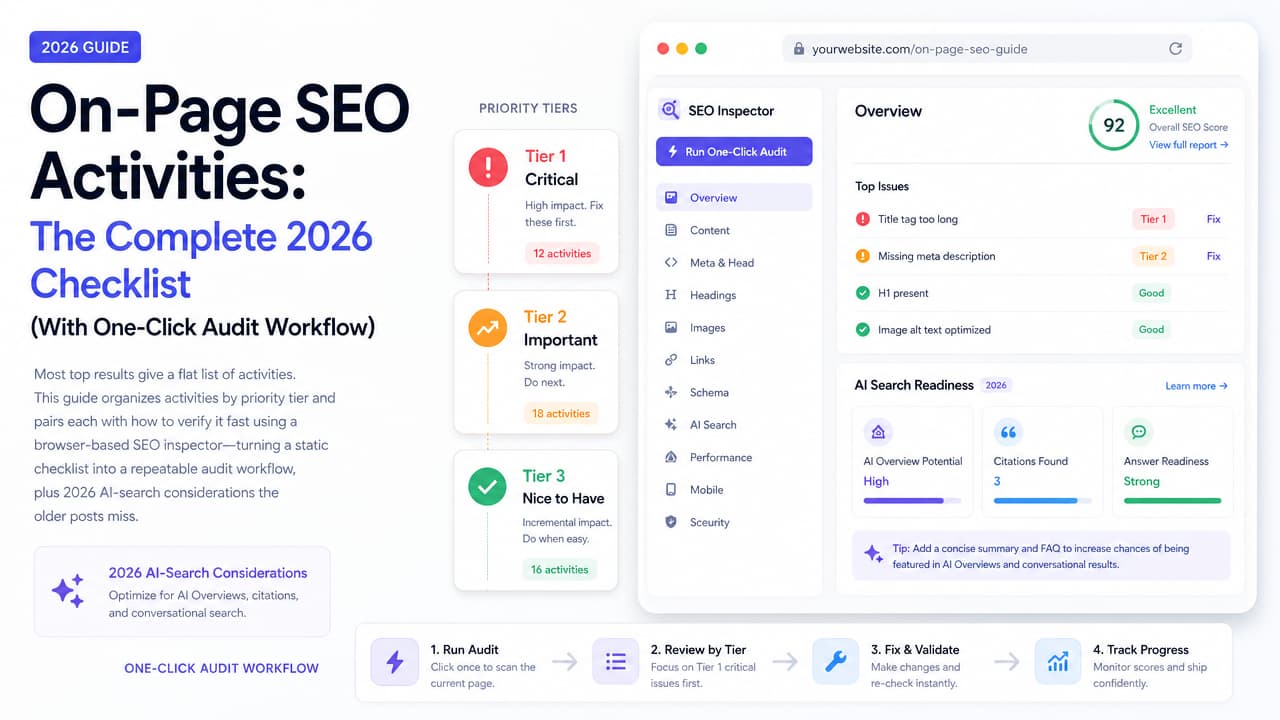
On-page SEO activities are the optimizations you make directly on a web page—its content, HTML tags, and structure—so search engines and AI systems can understand and rank it. The core list is short and well-established: target the right keywords, write strong title tags and meta descriptions, use a single clear H1 with a logical header hierarchy, publish unique in-depth content, add internal links and image alt text, clean up URL slugs, apply schema markup, set canonical tags, and hit Core Web Vitals and mobile-friendliness. Below, we organize these into priority tiers and pair each with a fast way to verify it—so your checklist becomes a repeatable audit, not a static wish list.
Google AI Overviews now appear directly in the search results for queries like this one, which means on-page work has to satisfy both classic ranking signals and generative answer engines. We cover that 2026 angle too.
The On-Page SEO Activities Checklist at a Glance
Most top guides—WooRank's 20-point checklist, Semrush's task list, Siteimprove's 16 techniques—cover the same fundamentals. Here they are in one scannable list:
- Identify target keywords for the page's primary intent.
- Optimize the title tag with the keyword and compelling copy.
- Write a meta description that earns the click.
- Use one descriptive H1 that matches the topic.
- Structure headers logically with H2s and H3s.
- Publish unique, useful content that fully answers the query.
- Add internal links to related pages with descriptive anchors.
- Write image alt text for every meaningful image.
- Create clean URL slugs that are short and readable.
- Implement schema markup to clarify entities and content type.
- Set canonical tags to consolidate duplicate URLs.
- Pass Core Web Vitals and keep page speed fast.
- Ensure mobile-friendliness across screen sizes.
On-page SEO refers to everything you control on the page itself. Off-page SEO covers signals that happen elsewhere—backlinks, brand mentions, and citations. Both matter, but only on-page work is fully in your hands, which is why it's the fastest place to improve.
What Is On-Page SEO (and How It Differs From Off-Page)
On-page SEO is the practice of optimizing content, structure, and HTML elements on a page so search engines and AI systems can understand it. That definition, echoed by WordStream and HubSpot, is the anchor for everything on this list. If a search engine can crawl your page, parse its headings, and read its structured data, it can rank it—and quote it in an AI Overview.
Off-page SEO happens away from your page. A common example of an off-page SEO activity is earning a backlink from a reputable industry publication; other examples include unlinked brand mentions, guest contributions, and digital PR. These build authority, but you can't edit them on demand. For a full breakdown, see the off-page SEO ranking factors that both search engines and AI systems weigh.
| Aspect | On-Page SEO | Off-Page SEO |
|---|---|---|
| Location | On the page itself | Across the wider web |
| Examples | Titles, headers, content, schema | Backlinks, brand mentions, PR |
| Control | Full and immediate | Indirect, earned over time |
| Audit speed | Verifiable in one click | Requires external tools |
On-Page SEO Activities Organized by Priority Tier
A flat list tells you what to do but not what to do first. We group activities into three tiers by impact and effort, and give each a one-line "what to check" so you can audit as you go. If you'd rather work from a fully sequenced plan, our prioritized on-page SEO strategy orders every element by impact.
Tier 1: Foundational Quick Wins
These are the highest-leverage on-page SEO activities. Fix them first because they shape how both users and search engines interpret the page.
- Target keyword identification. Pick one primary keyword and its close intent variants. Check: the keyword appears in the title, H1, and opening paragraph.
- Title tag optimization. Lead with the keyword and add a reason to click. Keep it roughly 50–60 characters so it doesn't truncate. Check: the title is unique, present, and within length.
- Meta description. Summarize the page and include the keyword naturally, around 150–160 characters. Check: it exists, isn't duplicated, and reads as a compelling pitch.
- Single descriptive H1. One H1 per page that states the topic clearly. Check: there's exactly one H1 and it matches the title's intent.
- Clean URL slug. Short, lowercase, keyword-bearing, no tracking clutter. Check: the slug is readable and free of stop words and IDs.
Each of these is one of the on-page SEO tags worth auditing carefully, since a missing or duplicated one quietly undercuts the whole page.
Tier 2: Content Depth and Structure
Tier 2 is where you win on relevance. Siteimprove's first technique is building content around strategic keyword clusters, and depth is what earns quotes in AI answers. Knowing exactly where on-page SEO keywords belong keeps that depth from tipping into stuffing.
- Keyword clusters. Cover the main topic plus related subtopics and questions, not a single phrase. Check: the page addresses the obvious follow-up questions a reader would ask.
- Targeted, unique content. Original, useful, and thorough—no thin or duplicated pages. Check: the content offers something the top competing pages don't.
- Logical header hierarchy. H2s for main sections, H3s nested beneath them. Check: headings form a clean outline with no skipped levels.
- Internal linking. Link to relevant pages with descriptive anchor text. Check: every page links to and from related content.
- Image alt text. Describe each meaningful image for accessibility and image search. Check: no important image has an empty alt attribute.
- Content freshness. Update stats, examples, and dates on a schedule. Check: the page reflects current information and a recent review date.
2026 angle: structure sections so an AI system can lift a clean answer. Start each section with a direct one- or two-sentence answer, then expand. Use question-style headings, bullet lists, and tables where you compare options—these formats are easy for generative engines to extract.
Tier 3: Technical On-Page Elements
Tier 3 is the polish that helps crawlers and AI systems trust and process your page. It's less glamorous but catches problems that silently suppress rankings.
- Schema markup. Add structured data (Article, FAQ, Product, etc.) to clarify what the page is about. Check: valid schema is present and matches the visible content.
- Canonical tags. Point duplicate or parameterized URLs to the preferred version. Check: the canonical resolves to the correct, indexable URL.
- Core Web Vitals and page speed. Fast loading, stable layout, quick interactivity. Check: the page meets Google's LCP, CLS, and interaction thresholds.
- Mobile-friendliness. Responsive layout, tappable elements, readable text. Check: the page renders cleanly on a phone without horizontal scroll.
- Crawlability signals. Correct robots directives, no accidental noindex, working internal links. Check: the page is indexable and free of crawl blockers.
These elements support search engines and AI systems alike: structured data feeds entity understanding, canonicals prevent diluted signals, and speed affects both ranking and the likelihood your content is used in a generated answer.
How to Audit These Activities in One Click
Here's the workflow most guides skip. A checklist is only useful if you can verify each item quickly on a live page. That's exactly what a browser-based inspector does—and where Argus, the AI-powered SEO Chrome extension by Pixelesq, fits.
Instead of copying URLs into a dashboard, you open the page you want to audit and let Argus surface the on-page signals in the tab you're already in:
- Titles and meta descriptions — present, unique, and within length.
- Header structure — a single H1 and a clean H2/H3 outline.
- Image alt text — flags images missing descriptions.
- Schema and canonical tags — confirms structured data and the preferred URL.
- AI-powered insights — plain-language suggestions on what to fix first.
This turns the static Tier 1–3 checklist into a repeatable per-page audit. You run it on a new blog post before publishing, on a competitor's page to see how they structure content, or across your top landing pages during a monthly review. Our on-page SEO audit walkthrough shows the full in-browser workflow step by step.
When to reach for a heavier crawler instead
Full-site crawlers like Screaming Frog and platforms like Semrush are the right tool when you need to audit thousands of URLs, track rankings over time, or map site-wide link structures. A one-click inspector is built for a different job: fast spot-checks on individual pages while you work. Most teams use both—the crawler for the periodic deep dive, the extension for everyday verification. If you're weighing options, our roundup of the best on-page SEO analysis tools compares them by workflow.
| Task | One-click inspector (Argus) | Full-site crawler |
|---|---|---|
| Check a single live page | Instant, in-tab | Overkill |
| Pre-publish QA | Ideal | Slow |
| Competitor spot-check | Fast | Requires setup |
| Crawl 10,000 URLs | Not the use case | Ideal |
On-Page SEO for 2026: AI Search Considerations
Older on-page posts stop at title tags and word counts. The 2026 guides from Semrush, HubSpot, and WordStream now explicitly frame on-page work around AI-generated answers—because AI Overviews appear right in the results for many queries. Optimizing for them is an extension of good on-page SEO, not a separate discipline.
- Answer first. Open each page and each section with a direct answer, then support it. Generative engines favor content they can quote cleanly.
- Send clear entity and topic signals. Name the concepts, people, and products explicitly. Consistent, unambiguous language helps AI systems map your page to a topic.
- Use structured data. Schema helps machines classify your content and pull the right facts into an answer.
- Write concise, question-based sections. Headings phrased as questions with tight answers below are easy to extract—and they match how people prompt AI tools.
- Keep content current and accurate. AI systems favor trustworthy, up-to-date sources, so freshness compounds.
None of this replaces the fundamentals. It rewards pages that were already well-structured, clearly written, and technically sound—the same pages your on-page checklist produces. For deeper tactics, our guide to advanced on-page SEO techniques goes further.
Common On-Page SEO Mistakes to Avoid
Every item below is something a quick audit catches immediately—which is the whole point of verifying as you go.
- Keyword stuffing. Repeating a phrase unnaturally hurts readability and rankings. Write for humans first.
- Duplicate or missing title tags. Two pages sharing a title—or a page with none—confuses search engines. Every page needs a unique title.
- Thin content. Pages that don't fully answer the query lose to deeper competitors and rarely earn AI citations.
- Broken internal links. Dead links waste crawl budget and frustrate users. Fix or remove them.
- Missing image alt text. Empty alt attributes cost you accessibility and image-search visibility.
- Ignoring mobile. A layout that breaks on phones undercuts both ranking and conversions.
- Multiple or missing H1s. Ambiguous heading structure muddies the page's main topic.
On-Page SEO Activities Checklist (Downloadable Summary)
Use this as a copy-ready checklist and run it page by page. It works for beginners and it's free to apply today—no template purchase required. Pair it with a step-by-step optimization checklist when you're ready to make changes rather than just verify them.
- ☐ Primary keyword identified and mapped to intent
- ☐ Title tag: unique, keyword-led, ~50–60 characters
- ☐ Meta description: compelling, ~150–160 characters
- ☐ Exactly one descriptive H1
- ☐ Logical H2/H3 hierarchy, no skipped levels
- ☐ Unique, in-depth content covering the keyword cluster
- ☐ Answer-first sections for AI Overviews
- ☐ Internal links with descriptive anchors
- ☐ Alt text on every meaningful image
- ☐ Clean, readable URL slug
- ☐ Valid schema markup in place
- ☐ Correct canonical tag
- ☐ Core Web Vitals passing, fast load
- ☐ Mobile-friendly rendering
- ☐ Page indexable, no broken links
The fastest way to work through this list is to inspect each page live. Install Argus by Pixelesq and run a one-click, AI-powered audit on any page—titles, headers, alt text, schema, and more—without leaving the tab. It's the difference between owning a checklist and actually clearing it.
Frequently Asked Questions
What are the best practices for on-page SEO?
Start with keyword research, then optimize the title tag, meta description, and a single H1. Publish unique, in-depth content organized under a clean H2/H3 hierarchy, add internal links and image alt text, use clean URL slugs, and cover the technical layer—schema, canonicals, Core Web Vitals, and mobile-friendliness. Verify each item on the live page, and see our full best on-page SEO practices checklist for the details.
How do I implement on-page SEO step by step?
Work in tiers. First, fix foundational elements (keywords, title, meta, H1, URL). Second, deepen content, structure headers, and add internal links and alt text. Third, handle technical items like schema, canonicals, and page speed. Finally, run a one-click audit to confirm nothing was missed before you publish.
What is an example of an off-page SEO activity?
Earning a backlink from a reputable industry site is a classic off-page SEO activity. Other examples include unlinked brand mentions, digital PR, and guest contributions—signals that happen away from your page and build authority over time.
What are effective off-page SEO activities for 2026?
Focus on earning quality backlinks from relevant, authoritative sources, building genuine brand mentions and citations, and digital PR that gets your brand referenced by trusted publications. These reinforce the trust signals that both search engines and AI systems weigh.
How can I check my on-page SEO in one click?
Use a browser-based inspector like Argus, the Chrome extension by Pixelesq. Open any page and it surfaces titles, meta descriptions, headers, alt text, schema, and canonical tags—plus AI-powered suggestions—so you can check on-page SEO online in one click without a full-site crawl.
Is on-page SEO still important with AI search?
Yes—more than ever. AI Overviews and generative answers pull from well-structured, trustworthy pages. Answer-first content, clear entity signals, and structured data are on-page techniques, so strong on-page SEO is what makes your content eligible to be quoted by AI systems.

