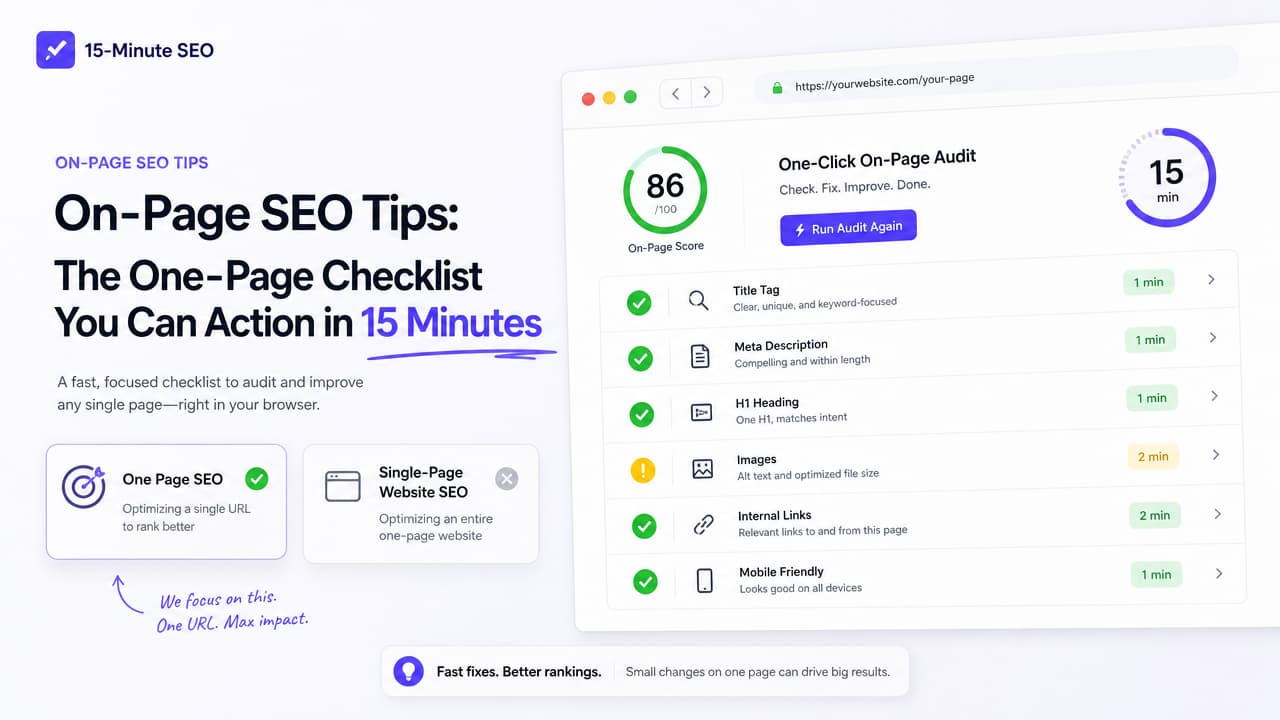
If you want quick one page SEO tips you can action right now, here's the short version: give the page a unique title tag with your primary keyword, write an accurate meta description, use a single H1 with a logical H2/H3 structure, place your keyword in the first 100 words, keep the URL slug short and clean, add relevant internal links, write descriptive image alt text, break content into short scannable paragraphs, and make sure the page loads fast on mobile. Everything else is refinement.
Below, each tip is organized by how fast you can inspect and fix it in-browser — because the fastest way to improve a page is to see its actual meta layer, headings, links, and speed signals without digging through source code. Let's work through the checklist.
The Fast Answer: The Core On-Page SEO Tips for a Single Page
On-page SEO is everything you control on the URL itself. Here is the tight, scannable on-page SEO checklist that resolves most single-page optimization needs:
- Unique title tag containing your primary keyword, written for humans first.
- Accurate meta description that summarizes the page and earns the click.
- One H1 plus a logical H2/H3 hierarchy that maps the content.
- Primary keyword in the first 100 words so intent is clear immediately.
- Short, clean URL slug without long phrasing or special characters.
- Internal links with descriptive anchor text pointing to related pages.
- Descriptive image alt text for accessibility and image search.
- Readable formatting — short paragraphs, clear headings, and white space.
- Fast, mobile-friendly loading so the page performs on any device.
This mirrors what the top-ranking guides all repeat: Semrush emphasizes accurate title tags, optimized URL slugs, and meta descriptions; Loganix recommends putting your primary keyword in the first 100 words; and Ahrefs stresses short paragraphs, clear headings, and plenty of white space. If you knock out these items on a single URL, you've handled the bulk of on-page optimization. An on page seo checker can confirm each one in seconds — more on that at the end.
'One Page SEO' vs Single-Page Website SEO: Which One Do You Mean?
Searchers use "one page SEO" to mean two different things, and most guides blur them. Getting the distinction right saves you from applying the wrong fixes.
Interpretation 1: Optimizing one page (a single URL)
This is the common case — you have a multi-page website and you want to optimize one specific page or blog post. Nearly every tip in this article applies: the title tag, meta description, headings, keyword placement, internal links, images, and speed for that single URL. You're tuning one page inside a larger site.
Interpretation 2: Optimizing a single-page (one-URL) website
This is a website that lives entirely on one URL — a portfolio, landing page, or scrolling one-pager. Here, the priorities shift. According to SE Ranking, to optimize a single-page website you should improve page speed and mobile compatibility, establish a clear content hierarchy, and compress images. Because you only have one URL, you can't spread keywords across many pages, so section structure and internal jump-links carry more weight.
The rest of this guide applies to both, but note the emphasis: single-URL sites should lean hard into content hierarchy, speed, and compressed images, since those are the levers you actually have. If you have a full site, treat each page individually with the complete checklist.
Optimize the Meta Layer: Title Tags, Meta Descriptions & URL Slugs
The meta layer is what search engines and users see first, and it's the fastest thing to inspect. These are the on page SEO factors that punch above their weight relative to how quickly you can fix them.
Title tags
Write a unique title tag for each page — and, as Loganix puts it, write it for users, not just search engines. Front-load your primary keyword so it's visible even when the title gets truncated in the SERP. Keep it descriptive and specific to the page's content. A generic or duplicated title tag is one of the most common wasted opportunities on the web.
Meta descriptions
Semrush recommends writing accurate meta descriptions that genuinely reflect the page. This snippet doesn't directly rank you, but it influences click-through. Summarize the value of the page, include your keyword naturally, and give a reason to click. If you leave it blank, Google will scrape a fragment that may not sell the page well.
URL slugs
Keep your slug short and readable. Squarespace advises avoiding overly long phrasing and special characters. A clean slug like /on-page-seo-tips beats a messy string of stop words and query parameters. Include the keyword, drop the filler.
The catch with the meta layer is visibility. You can't see the title, meta description, and canonical tag on a rendered page — traditionally you'd open View Source and hunt through markup. A one-click SEO inspector surfaces all of it instantly, so you can spot a missing description or duplicate title without touching code.
Structure Content for Robots and Readers
Once the meta layer is clean, structure the content so both search engines and people can follow it. This is where on-page SEO techniques meet plain readability.
Heading hierarchy
Use a single H1 that states what the page is about, then nest H2s for main sections and H3s for subsections. A logical outline helps crawlers understand relationships between ideas and helps readers scan. Skipping levels or stacking multiple H1s muddies the signal.
Keyword placement and semantics
Put your primary keyword in the first 100 words so intent is obvious from the top. Then support it with semantic keywords — related terms and phrases your audience naturally uses. This isn't about density; it's about covering the topic thoroughly enough that the page reads as a complete answer.
Formatting for humans
Ahrefs sums up readable content well: short paragraphs, clear headings, plenty of white space, and a layout designed for your target audience. A technical blog can go denser; a consumer landing page needs breathing room. Break walls of text into two-to-four sentence paragraphs and use lists where they help.
The 3 C's framing
A useful shorthand for on-page quality is the 3 C's: content (does the page genuinely satisfy the query?), code (is the HTML clean, with proper headings and structured data?), and credibility (does it demonstrate expertise and trust?). Search Engine Journal echoes the credibility angle — showing expertise, authoritativeness, and trustworthiness (E-E-A-T) is part of good on-page SEO. When you're deciding what "best on-page SEO techniques" means for your page, run it through those three lenses.
Links, Images & Accessibility Wins
These elements are easy to overlook and easy to fix, and several of them double as accessibility improvements that also help SEO.
Internal links and navigation
Squarespace calls out adding internal links and managing navigation as a core on-page step. Internal links spread authority across your site and help users (and crawlers) discover related content. Use descriptive anchor text that explains where the link goes — "our on-page SEO checklist" is far better than "click here."
Images
Compress images so they don't drag down load time, and write descriptive alt text for every meaningful image. Alt text serves screen readers, gives search engines context, and provides a fallback when images fail to load. It's one of the highest-leverage accessibility-and-SEO overlaps on any page.
Accessibility as an on-page factor
Siteimprove frames the basics well: use clear headings, maintain strong color contrast, write link text that explains its destination, and make sure forms are usable. Accessibility is an underrated on-page ranking and UX factor. Pages that are easier for everyone to use tend to have better engagement signals — and you're serving a wider audience at the same time.
Technical On-Page Factors: Speed, Mobile & Core Web Vitals
The other half of on-page SEO is technical performance. These factors live on the page but are about how it loads and behaves, and a page-level audit tool flags them fast.
- Page load speed: Mangools lists improving page loading speed as a top priority. Slow pages lose users and rankings.
- Proper hosting: Choose reliable hosting so your server response time doesn't bottleneck everything else.
- Image optimization: Compress and correctly size images — often the single biggest speed win.
- Browser caching: Enable caching so returning visitors don't re-download unchanged assets.
- CDN: A content delivery network serves assets from locations closer to your users.
- Mobile-friendliness: With mobile-first indexing, the page must work cleanly on small screens.
Core Web Vitals — loading, interactivity, and visual stability — roll these signals into measurable metrics Google cares about. You don't need to memorize the thresholds; you need to know whether a given page passes and, if not, what's dragging it down. That's exactly the kind of check a technical SEO audit handles for you at the page level.
The 80/20 of On-Page SEO: Where to Spend Effort First
You don't need to do all 30 things at once. The 80/20 rule in SEO means a small share of fixes drives most of the results. For on-page work, that handful is:
- Match search intent — make sure the page actually answers the query it targets.
- Nail the title tag — the highest-visibility on-page element.
- Fix heading structure — one H1, logical H2/H3s, keyword in the first 100 words.
- Add internal links — connect the page to related content with good anchor text.
- Improve speed and mobile — remove the friction that kills engagement.
Get these five right and you've captured most of the available gain. The remaining tips are refinements that compound over time. If you want them sequenced by impact rather than as a flat list, an on-page SEO strategy framework helps you decide what to tackle first.
Is SEO dead now with AI?
No. AI Overviews and AI-driven results still pull from well-structured, credible pages — and traditional SERPs aren't going anywhere. If anything, clean on-page signals (clear headings, direct answers, structured content) make a page easier for AI systems to parse and cite. The fundamentals in this guide are what help you show up in both classic search and AI answers.
Audit Any Page in One Click with Argus
The checklist above is straightforward, but manually verifying every item — cracking open source code to read the title tag, counting headings, checking each image's alt text, testing speed — is slow. This is where an SEO Chrome extension turns the checklist into an automated workflow.
Argus by Pixelesq is the all-seeing SEO inspector: a Chrome extension that delivers AI-powered SEO insights and audits in one click. Open any live page and Argus inspects the meta layer, heading hierarchy, internal and external links, image alt text, and speed signals instantly — no View Source, no copy-pasting into five different tools.
- See the meta layer at a glance: title tag, meta description, and slug, flagged if missing or duplicated.
- Check structure: H1/H2/H3 hierarchy and keyword placement, surfaced without digging through markup.
- Review links and images: spot thin anchor text and missing alt attributes in seconds.
- Get AI-powered insights: a one click SEO audit that explains what to fix and why, not just a raw score.
If you want to check a website's SEO score and act on it the same minute, install Argus and run an AI SEO analysis on your most important page. Turn this on-page checklist into a repeatable, one-click habit.
Frequently Asked Questions
What is the 80/20 rule in SEO?
It's the idea that roughly 80% of your results come from about 20% of your efforts. For on-page SEO, prioritize the highest-impact fixes first — search intent match, title tags, heading structure, internal links, and page speed — before spending time on smaller refinements.
Is SEO dead now with AI?
No. On-page SEO still matters for both AI Overviews and traditional search results. Clean structure, credible content, and clear answers make pages easier for AI systems to understand and cite, so the fundamentals remain essential.
What are the best on-page SEO techniques?
The most reliable techniques are unique keyword-rich title tags, accurate meta descriptions, a single H1 with logical subheadings, the primary keyword in the first 100 words, short readable paragraphs, descriptive internal links, optimized images with alt text, and fast mobile performance. If you'd rather follow a guided sequence, this step-by-step checklist walks through each fix.
What are the 3 C's of SEO?
A common framing is content, code, and credibility. Content means genuinely satisfying the query; code means clean, well-structured HTML with proper headings; and credibility means demonstrating expertise, authoritativeness, and trust (E-E-A-T).
How do I optimize a single-page website for SEO?
For a one-URL website, improve page speed and mobile compatibility, establish a clear content hierarchy with logical sections, and compress your images. Because you only have one URL, lean into strong section structure and internal jump-links rather than spreading keywords across many pages.

