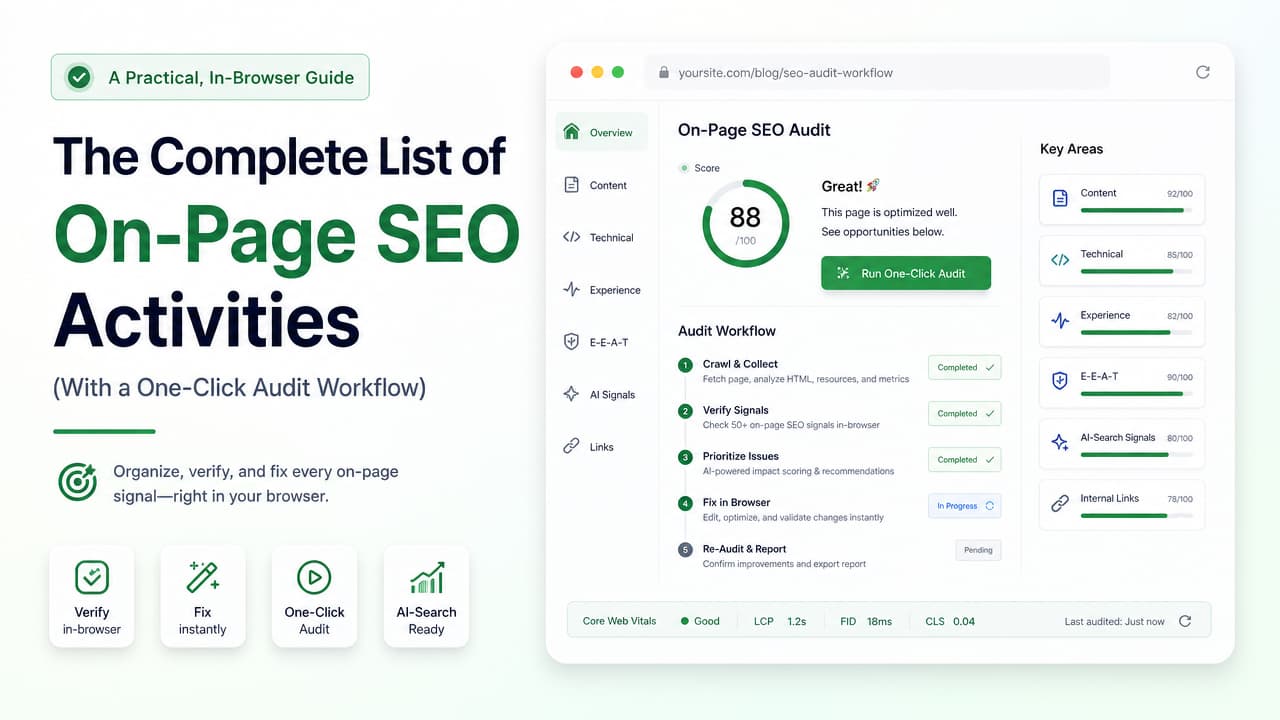
Here is the complete list of on page seo activities, grouped so you can actually run it as an audit rather than admire it as a poster. On-page SEO covers everything you control on the page itself—content, HTML tags, media, internal links, and the technical and experience signals that render in the browser—as opposed to off-page factors like backlinks and brand mentions that live elsewhere.
This set consolidates the well-known lists into one deduplicated workflow: the 14-step Semrush checklist, WooRank's 20-point breakdown, and PQube's top-10 techniques. Instead of a static checklist, each activity below maps to something you can verify and fix on a live page in seconds.
The On-Page SEO Activities List at a Glance
Scan the full grouped list first, then dig into the sections that follow for the how and why.
| Group | Activities |
|---|---|
| Content | Keyword research, intent matching, target keyword in first 100 words, content depth, freshness updates, readability |
| HTML / Meta | Title tag optimization, meta description, single H1, logical H2/H3 hierarchy, clean URL slug |
| Media | Image alt text, descriptive file names, compression and next-gen formats, video optimization |
| Internal Linking | Descriptive anchor text, contextual internal links, orphan page fixes, topic clusters and pillar pages |
| Technical / UX | Core Web Vitals (LCP, INP, CLS), mobile-friendliness, HTTPS, canonical tags, page speed, structured data |
| AI-Search Signals | Clear answer formatting, author bylines and credentials, citations, entity clarity, extraction-ready structure, E-E-A-T |
Every one of these is a page-level lever. That distinction matters: on-page work is the part of SEO you can fully control and change today, without waiting on other websites to link to you. If you want the full factor breakdown, our guide to on-page SEO topics maps each element to a self-audit action.
Content Optimization Activities
Content is where on-page SEO starts, because search engines and AI systems both reward pages that answer the query completely.
Keyword research and intent matching
Pick a primary keyword and confirm what searchers actually want when they type it. A query like "best on page seo checker" wants a tool comparison, not a definition. Match the format—guide, list, comparison, or product page—to the dominant intent on the results page. AI-powered keyword research tools can help you cluster ideas by intent.
Target keyword placement
Place your target keyword in the first 100 words of the body so both readers and crawlers confirm the topic immediately. Semrush explicitly lists strategically placing target keywords as a core on-page task. Work related terms in naturally through the rest of the copy—no stuffing. There are actually eight places on-page keywords belong, from the title to alt text.
Depth, freshness, and readability
- Depth: Cover the subtopics competitors cover, plus the questions they miss.
- Freshness: Update stats, examples, and dates on a schedule so the page reflects the current year.
- Readability: Short paragraphs, plain language, and scannable subheads keep people on the page.
Title Tags, Meta Descriptions & Header Structure
The HTML layer tells search engines what the page is about before anyone reads a word. Networsys frames the on-page action plan around exactly this: audit title tags and meta descriptions for keyword placement and compelling copy, then review your headers. These are the on-page SEO tags worth auditing on every page.
Title tag optimization
Include your primary keyword and write copy that earns the click. Keep it under roughly 60 characters so it doesn't truncate. One clear, unique title per page.
Meta description writing
Meta descriptions don't directly rank you, but they influence click-through. Write a concise summary that includes the keyword and a reason to click, around 150–160 characters.
Header hierarchy
Use a single H1 that states the page topic, then structure the body with logical H2s and H3s. This hierarchy helps readers scan and helps AI systems extract sections cleanly.
URL slug optimization
Keep URLs short, lowercase, and descriptive—include the keyword, drop stop words and dates. A slug like /on-page-seo-activities beats a string of query parameters.
Images, Media & Schema Markup
Media and structured data are the on-page activities most teams skip—and the ones that increasingly feed rich results and AI answers.
Image and video optimization
- Alt text: Describe each meaningful image accurately; it aids accessibility and image search.
- File names: Use descriptive names like
core-web-vitals-report.pnginstead ofIMG_4821.png. - Compression and formats: Serve compressed, next-gen formats (WebP/AVIF) so images don't drag your load time.
- Video: Add transcripts and captions so the content is indexable.
Schema markup
Structured data (schema) tells search engines exactly what an element is—an article, product, FAQ, or author. It powers rich results in traditional search and gives AI systems machine-readable context to cite. Article, FAQ, and Author schema are high-value starting points for most content pages.
Internal Linking & Site Architecture
Internal links spread authority across your pages and show search engines how topics relate. They're fully on-page and fully in your control.
- Descriptive anchor text: Link with words that describe the destination, not "click here."
- Contextual links: Connect related pages from within the body copy where the reference is natural.
- Orphan page fixes: Every important page should be reachable through at least one internal link. Orphans rarely rank.
- Topic clusters: Build a pillar page for a broad topic and link supporting articles to and from it. This signals subject authority and keeps users moving through related content.
Technical & UX Activities That Live On the Page
Some technical factors are page-level, meaning you can inspect and fix them per URL. Swydo highlights Core Web Vitals and E-E-A-T as modern must-haves, not optional extras.
Core Web Vitals
Google's three experience metrics all render on the page:
- LCP (Largest Contentful Paint): How fast the main content loads.
- INP (Interaction to Next Paint): How quickly the page responds to input.
- CLS (Cumulative Layout Shift): How stable the layout stays while loading.
Mobile, HTTPS, canonicals, and speed
- Mobile-friendliness: The page must be usable and readable on small screens.
- HTTPS: Serve every page securely.
- Canonical tags: Point duplicate or similar URLs to the preferred version to avoid splitting ranking signals.
- Page speed: Trim render-blocking scripts and heavy assets so the page loads fast.
On-Page Signals for AI Search and E-E-A-T
This is where the older lists fall short. An AI Overview appears for this very query, and both Swydo and Semrush flag AI optimization as a defining 2026 trend. The on-page activities that earn visibility in AI answers are specific and worth doing deliberately.
- Clear answer formatting: Lead sections with a direct answer, then expand. AI systems extract concise, self-contained statements.
- Author bylines and credentials: Name the author and show relevant expertise. This is the "Experience" and "Expertise" in E-E-A-T.
- Citations: Reference credible sources so claims are verifiable—a trust signal for both readers and algorithms.
- Entity clarity: Name people, products, and organizations precisely and consistently so systems map your content to the right entities.
- Extraction-ready structure: Use short paragraphs, descriptive headings, lists, and tables that models can lift as a clean answer.
E-E-A-T—Experience, Expertise, Authoritativeness, and Trustworthiness—isn't a single tag you toggle on. It's the cumulative effect of who wrote the page, how well it's sourced, and how clearly it demonstrates first-hand knowledge.
How to Turn the List Into a Repeatable One-Click Audit
A checklist you check by hand once a quarter isn't a workflow. The point is to verify each activity on any live page, quickly, so the list becomes a per-page audit you run in seconds. If you'd rather follow it step by step, our on-page SEO audit checklist walks through each element.
Here's what "checking in-browser" looks like for each group:
- Content: Confirm the target keyword appears early and word count matches the depth of the query.
- HTML / Meta: Inspect the title tag, meta description, single H1, and heading hierarchy without digging through source code.
- Media: Spot images missing alt text and oversized files.
- Internal links: See the on-page links and their anchor text at a glance.
- Technical: Read the canonical tag, check for HTTPS, and review Core Web Vitals and schema.
That's exactly what Argus, the all-seeing SEO inspector, was built for. As a Chrome extension, Argus delivers AI-powered SEO insights and a full audit in one click—surfacing title tags, meta descriptions, headers, alt text, canonicals, schema, word count, and the on-page signals above for whatever page you're viewing. Instead of copying the list into a spreadsheet and inspecting each element manually, you open the page and read the findings.
Whether you're a content strategist auditing a draft, a marketer spot-checking a landing page, or a developer verifying a fix, this turns the whole activities list into a fast, repeatable check. Install the Argus Chrome extension and run your first one-click on-page SEO audit today.
On-Page vs Off-Page vs Technical: The 80/20 Priorities
The three disciplines overlap, so it helps to draw the lines clearly:
| Type | What it covers | Examples |
|---|---|---|
| On-page | Content and elements on the page itself | Title tags, content, headers, internal links, alt text |
| Technical | Crawlability and site-wide infrastructure | Site speed, XML sitemaps, indexing, HTTPS, Core Web Vitals |
| Off-page | Signals earned outside your site | Backlinks, brand mentions, digital PR, reviews |
Several technical factors—Core Web Vitals, canonicals, mobile-friendliness—are also on-page because you inspect and fix them at the URL level. The boundaries blur, and that's fine. If the terminology still feels fuzzy, our plain-English on-page SEO definition clears it up with examples.
The 80/20 rule in SEO
The 80/20 rule (the Pareto principle) says roughly 20% of your activities drive about 80% of your results. For on-page SEO, that vital 20% is consistent:
- Compelling, keyword-optimized title tags
- Content that genuinely matches search intent
- Smart internal linking across a topic cluster
- Solid Core Web Vitals and mobile experience
Nail those before you fuss over the long tail of micro-optimizations. A prioritized on-page SEO strategy sequences the work by impact rather than treating it as a flat checklist.
Off-page activities for 2026
To round out the picture, effective off-page work for 2026 leans on quality over volume: earning links through original data and digital PR, building brand mentions and entity recognition across the web, gathering genuine reviews, and staying visible in the communities and platforms your audience trusts. These support the authority half of E-E-A-T that on-page signals alone can't fully carry.
Frequently Asked Questions
What does on-page SEO include?
On-page SEO includes everything you optimize on the page itself: content and keyword targeting, title tags, meta descriptions, header structure, URL slugs, images and alt text, internal links, schema markup, and page-level technical factors like Core Web Vitals and canonical tags.
What is the 80/20 rule in SEO?
It's the idea that about 20% of your efforts produce roughly 80% of your results. In on-page SEO, that high-impact minority is usually strong title tags, intent-matched content, internal linking, and good Core Web Vitals—prioritize those first.
What are the most effective on-page SEO techniques?
The highest-leverage techniques are matching search intent with comprehensive content, placing your target keyword in the title and first 100 words, using a clear H1/H2/H3 hierarchy, adding descriptive internal links, optimizing images, and structuring content for AI extraction with clear answers and E-E-A-T signals.
What are some off-page SEO activities for 2026?
Earning high-quality backlinks through original research and digital PR, growing brand mentions and entity recognition, collecting authentic reviews, and staying active where your audience already spends time. The focus is on trusted, quality signals rather than raw link volume.

