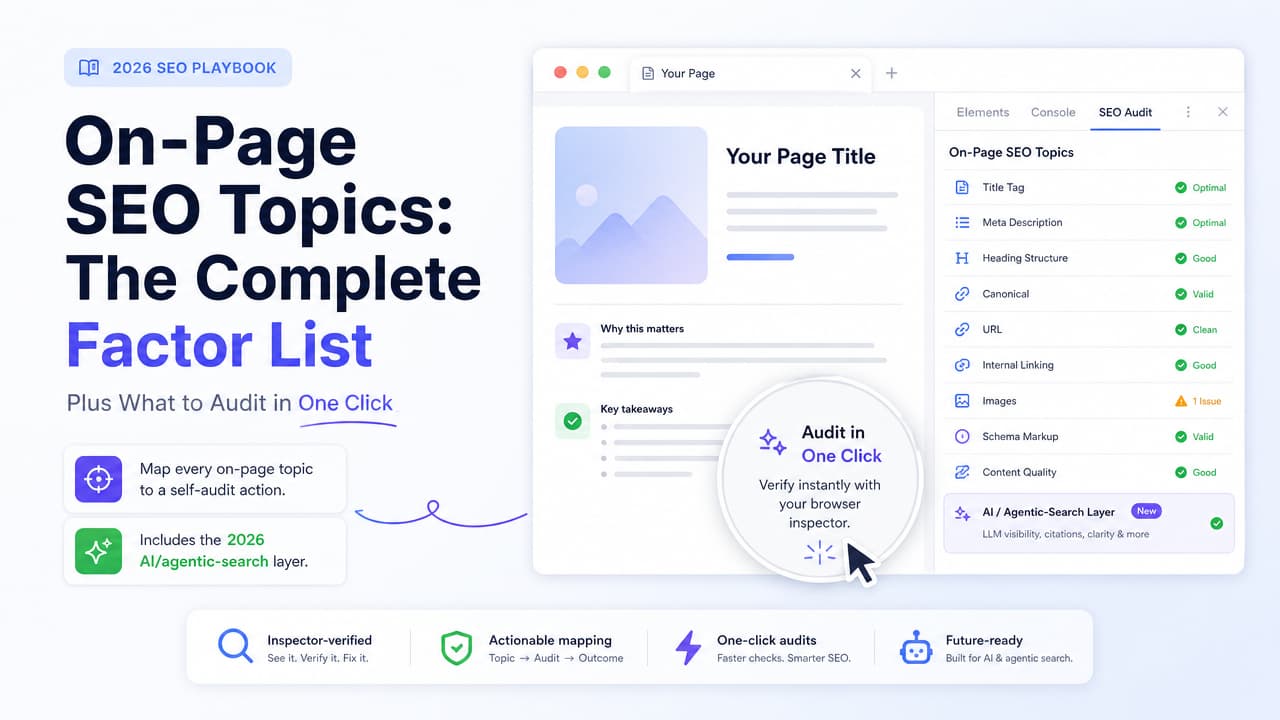
The core on page seo topics are the ranking factors you control directly on the page itself: title tags, meta descriptions, headings (H1–H6), URL structure, keyword placement, internal links, image alt text, content quality and depth, page speed and Core Web Vitals, structured data, and mobile-friendliness. Master those and you cover roughly 90% of what search engines and AI answer engines read on any given URL.
What follows is different from the usual static checklist. We map each on-page topic to a self-audit action you can verify instantly in your browser, and we add the 2026 AI and agentic-search layer that most guides bury. Let's start with the list, then make it actionable.
The On-Page SEO Topics That Actually Matter (Quick List)
Every major guide converges on the same set. WooRank's 20-point checklist, Semrush's 2026 task list, SEOptimer's complete guide, and Search Engine Journal's 13 essential factors all circle the same core elements. Here they are in one scannable list:
- Title tags — the clickable headline in search results
- Meta descriptions — the summary snippet under the title
- Headings (H1–H6) — the content hierarchy of the page
- URL structure — clean, readable, keyword-relevant paths
- Keyword placement — where your target terms appear
- Search intent match — does the content answer the query
- Content quality and depth — comprehensiveness and usefulness
- Internal links — how pages connect and pass authority
- Image alt text and optimization — accessibility and image search
- Page speed and Core Web Vitals — loading and interaction performance
- Structured data / schema markup — machine-readable context
- Mobile-friendliness — usability on small screens
The defining trait of every item above: it lives on the page you own. You can edit it, ship it, and verify it today. That's what separates on-page SEO from off-page factors like backlinks, which depend on other sites choosing to reference you. If you want the short version, our one-page checklist you can action in 15 minutes covers the essentials fast.
On-Page vs Off-Page vs Technical SEO: Where the Topics Split
People searching for the main topics in SEO often blur three distinct categories. Getting the boundaries right saves you from working on the wrong lever. If you want a plain-English breakdown, our definition of on-page SEO with examples lays it out. Here's the clean split:
| Category | What it covers | Examples |
|---|---|---|
| On-page SEO | Content and HTML on the page itself | Title tags, headings, keyword placement, alt text, internal links, content depth |
| Off-page SEO | Signals earned outside your page | Backlinks, brand mentions, reviews, social and PR signals |
| Technical SEO | Crawlability, indexing, and site architecture | XML sitemaps, robots.txt, canonical setup, site speed infrastructure, mobile rendering |
A few topics live in the overlap. Page speed is both an on-page experience factor and a technical infrastructure concern. Internal linking is an on-page editorial decision that also shapes site architecture. Structured data sits between on-page markup and technical implementation. Don't waste energy debating the label — just make sure each one gets checked.
Content-Level On-Page Topics
Content is the reason a page exists, and both Semrush and SEOptimer put content quality and keyword usage at the center of on-page work. These are the topics that decide whether a page deserves to rank at all.
Keyword research and placement
Pick one primary term per page, then place it where it counts: the title tag, the H1, the first 100 words, at least one subheading, and naturally throughout the body. Avoid stuffing — search engines and AI models both penalize unnatural repetition. Supporting keywords and synonyms signal topical breadth. Our guide to where on-page SEO keywords belong maps out all eight placements.
Search intent matching
The fastest way to lose a ranking is to answer the wrong question. If a query wants a definition, lead with a definition. If it wants a comparison, show a table. Look at what currently ranks: informational, transactional, or navigational. Match that format before you optimize a single tag.
Content depth and topical relevance
Comprehensive pages that cover a subject fully tend to outperform thin ones. Cover the subtopics a reader expects, answer the related questions, and connect the page to the rest of your topic cluster. Depth signals expertise; relevance keeps you on-topic.
Readability and freshness
Short paragraphs, clear subheadings, and plain language help humans and AI extractors alike. Freshness matters too — updated dates and current information tell search engines the page is maintained. A stale guide from 2022 loses ground to one refreshed for 2026.
HTML & Element-Level On-Page Topics
These are the most-cited elements across every top result, because they're the machine-readable signals that search engines parse first. For a deeper dive on each, see our full list of on-page SEO tags with examples.
- Title tags — Keep them around 50–60 characters so they don't truncate in results. Front-load the primary keyword and write for clicks, not just crawlers.
- Meta descriptions — Aim for roughly 150–160 characters. They don't directly rank you, but a compelling one lifts click-through rate.
- Header tags — Use a single H1 per page, then a logical H2/H3 hierarchy. Headings are a content outline for both readers and crawlers.
- Image alt text — Describe every meaningful image. It powers accessibility, image search, and gives AI systems extra context.
- Canonical tags — Point duplicate or similar URLs to the preferred version so authority isn't split.
Self-audit action: right-click and view source, or open your browser inspector, and confirm each page has exactly one H1, a filled title tag, a meta description within range, and alt attributes on images. That manual check works — it's just slow when you're auditing dozens of pages.
Structural On-Page Topics
Structure tells search engines how your content fits together. These topics rarely get the spotlight, but they quietly shape how authority flows through a site.
- URL structure — Short, descriptive, lowercase, hyphen-separated. A URL like
/on-page-seo-topicsbeats/page?id=4471for both users and crawlers. - Internal links — Links between your own pages distribute authority and help crawlers discover and understand relationships. Use descriptive anchor text, not "click here."
- Breadcrumb navigation — Breadcrumbs clarify site hierarchy for users and can appear in search results.
- Structured data / schema markup — Schema (FAQ, Article, Product, Breadcrumb) gives search engines explicit, machine-readable context about what a page contains.
Internal linking deserves extra attention. It's the on-page topic you fully control that most directly influences how pages rank relative to each other. A strong page linking to a weaker one shares equity and context in one move.
On-Page SEO for AI and Agentic Search (2026)
This is where most checklists stop short. An AI Overview already appears for the query "on page seo topics," and answer engines are reshaping what on-page optimization means. As Semrush puts it, on-page SEO "gives AI systems the structure, clarity, and topical signals they need to extract and cite your content."
In other words, the same clean headings, schema, and topical clarity that help Google also help AI models decide whether to quote you. Agentic search — where an AI agent reads, reasons, and cites sources on a user's behalf — rewards content that is easy to parse and extract. Here's how to optimize on-page for it:
- Answer-first paragraphs — Open sections with a direct, self-contained answer before the supporting detail. Extractors love a clean, quotable lead sentence.
- FAQ blocks — Question-and-answer formatting maps neatly to how people prompt AI, and it pairs well with FAQ schema.
- Definition-style content — State what something is in one crisp sentence. Definitions are highly citable.
- Consistent entity naming — Refer to people, products, and concepts by the same name throughout. Entity clarity helps AI connect your content to the right topic.
- Structured data — Schema is a direct line of communication to machine readers. It removes ambiguity about what your page covers.
The takeaway: strong on-page SEO is no longer only about blue links. Well-structured pages are more likely to be extracted and cited across AI Overviews and agentic search results — which means the on-page topics above now do double duty. For a sequenced approach, our prioritized on-page SEO framework orders these moves by impact.
How to Audit These On-Page Topics in One Click
You can check every topic above by hand — view source for tags, count H1s, hover images for alt text, tally internal links, dig for schema in the DOM. It works, but it's tedious across a whole site, and it's easy to miss something on page 40 of an audit. If you'd rather follow a repeatable process, our step-by-step on-page SEO audit checklist walks through it.
That's the gap Argus by Pixelesq — the All-Seeing SEO Inspector — closes. Argus is an AI-powered Chrome extension that surfaces every on-page factor and hands you prioritized fixes in one click, no manual view-source required. Here's what a one-click audit surfaces:
- Title and meta presence — flags missing, duplicate, or over-length tags instantly
- Heading hierarchy — confirms a single H1 and a logical H2/H3 structure
- Image alt coverage — counts images missing descriptive alt text
- Internal link mapping — shows how the page links out to the rest of the site
- Schema detection — identifies structured data already in place and what's missing
- AI-readiness signals — highlights the clarity and structure factors that matter for AI Overviews and agentic search
For Eva the content strategist, that means an SEO health check without leaving the page she's editing. For Tom in marketing, it's quick insight to steer strategy. For Nina learning development, it's a live, AI-powered checker of on-page SEO that teaches as it audits. The audit is free, one-click, and built for people who want answers, not spreadsheets. If you're weighing options, our roundup of the best on-page SEO analysis tools compares them by workflow.
Install Argus and run your first on-page audit — see every factor on this page in seconds.
On-Page SEO Topics: Priority Order for Beginners
If you're new to SEO, don't try to fix everything at once. Work this order — it puts the highest-leverage on-page topics first:
- Title tags and H1 — Get these right on every page first. They're the strongest, easiest on-page signals.
- Search intent and content match — Make sure the page actually answers the query in the right format.
- Internal links — Connect the page to related content with descriptive anchors.
- Images and page speed — Add alt text, compress files, and clear obvious speed bottlenecks.
- Schema and AI-readiness — Add structured data and answer-first formatting to earn citations in AI search.
Here's the same sequence as a starter reference you can keep beside you — and if you want the full walkthrough, see how to optimize on-page SEO step by step:
| Priority | Topic | Quick self-check |
|---|---|---|
| 1 | Title tag & H1 | One H1, filled title ~50–60 chars, keyword up front |
| 2 | Intent & content | Format matches what ranks; covers the subtopics |
| 3 | Internal links | Links to related pages with descriptive anchor text |
| 4 | Images & speed | Alt text present; images compressed; fast load |
| 5 | Schema & AI-readiness | Structured data added; answer-first paragraphs |
Rather than hunting down a static PDF, run Argus on any page to generate this same breakdown live — with your actual results filled in and the fixes ranked for you.
Frequently Asked Questions
What things are included in on-page SEO?
On-page SEO includes everything on the page you control: title tags, meta descriptions, headings, URL structure, keyword placement, internal links, image alt text, content quality and depth, page speed, structured data, and mobile-friendliness.
What are some of the best on-page SEO techniques?
Match search intent before optimizing tags, write compelling title tags with the keyword front-loaded, use a single H1 with a logical heading hierarchy, add descriptive internal links, cover the topic comprehensively, and add schema plus answer-first paragraphs for AI search. Our 2026 best-practices checklist has the full rundown.
What are the main topics in SEO?
SEO splits into three areas: on-page (content and HTML on the page), off-page (backlinks, mentions, and brand signals), and technical (crawlability, indexing, and site architecture). On-page is where you have the most direct control.
What are some good off-page SEO tasks to include?
Off-page work focuses on earning authority: building quality backlinks, generating brand mentions, collecting reviews, digital PR, and building a presence on relevant platforms. Unlike on-page topics, these depend on other sites and audiences.
How do you check on-page SEO for free?
You can check manually via browser view-source and the inspector, or run a free one-click audit with Argus by Pixelesq. The Chrome extension surfaces title tags, headings, alt text, internal links, schema, and AI-readiness with prioritized fixes — no manual checks needed.

